
Introduction: Why Your Code's Logic Is the Weakest Link
Every JavaScript file you ship to a browser is an open book. Minification removes whitespace. Identifier renaming turns calculateTotalPrice into a. String encoding hides your API endpoints. But none of these techniques touch the one thing that actually reveals how your application thinks: the order in which statements execute.
A reverse engineer can ignore your mangled variable names entirely. They can decode your strings. What they cannot easily ignore is the structure of your logic—the if/else branches, the loops, the sequence of operations that define what your code actually does. That structure is called control flow, and it is the richest source of intelligence for anyone trying to understand, copy, or attack your client-side code.
This guide is about the technique that specifically targets that vulnerability: control flow obfuscation. You will learn what it is, how it works under the hood, when to use it, what it costs in performance, and how to apply it using a free online tool that requires no installation.
What Is a Control Flow Obfuscator?
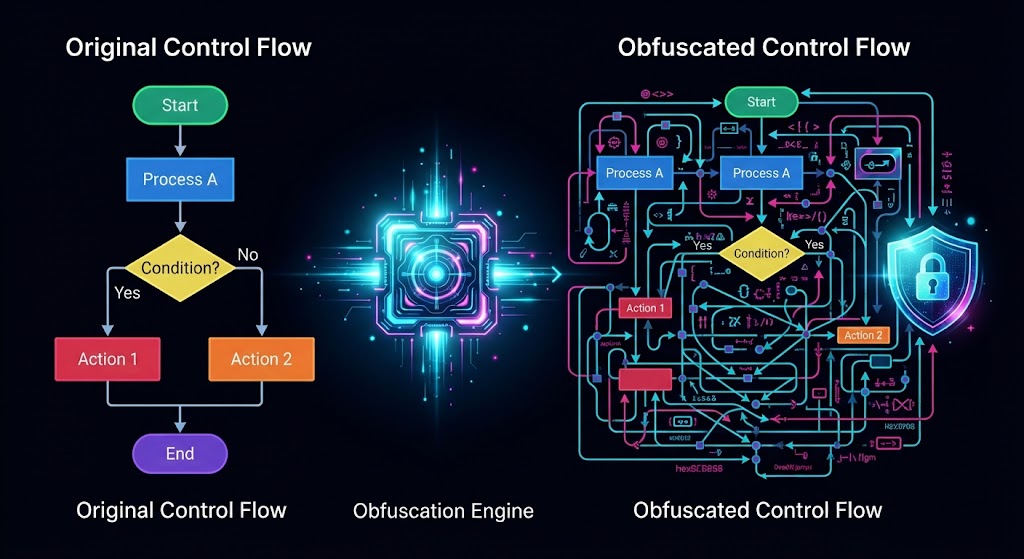
A control flow obfuscator is a tool that transforms the execution path of a program without changing its observable behavior. The output produces identical results—same outputs, same side effects, same errors—but the internal route the interpreter takes to reach those results becomes deliberately convoluted, non-linear, and hostile to human analysis .
The core insight is simple: if an attacker cannot follow the order of operations, they cannot understand what the code does. Renaming hides what things are called. Control flow obfuscation hides how things happen.
The most common implementation of this technique is called control flow flattening. Instead of a clean sequence of statements, the obfuscator rewrites the program into a state machine. A central switch statement acts as a dispatcher, and a state variable determines which block of code executes next. The original logical flow—which was obvious from top-to-bottom reading—is replaced by a loop that jumps between numbered cases in an order that only becomes clear at runtime .
Here is a simplified illustration of the transformation:
Before (readable logic):
javascript
function processOrder(order) { let total = 0; for (let item of order.items) { total += item.price * item.quantity; } if (order.discount) { total = total * (1 - order.discount); } return total; }
After (flattened control flow, conceptually):
javascript
function processOrder(order) { let state = 0; let total, items, i; while (true) { switch (state) { case 0: total = 0; items = order.items; i = 0; state = 1; break; case 1: if (i >= items.length) { state = 3; break; } total += items[i].price * items[i].quantity; i++; state = 1; break; case 3: if (order.discount) { state = 4; } else { state = 5; } break; case 4: total = total * (1 - order.discount); state = 5; break; case 5: return total; } } }
The flattened version does the same thing. But a human reader can no longer trace the logic linearly. They must simulate the state machine in their head—tracking the value of state through every iteration—just to understand a simple price calculation. At scale, across hundreds of functions and thousands of lines, this becomes prohibitively expensive.
How Control Flow Obfuscation Fits Into a Complete Protection Pipeline
No single technique is sufficient. Professional code protection layers multiple transformations, each covering a gap left by the others . Control flow obfuscation is the deepest layer, but it works best when combined with the basics.
| Technique | What It Hides | What It Does Not Hide |
|---|---|---|
| Minification | Whitespace, comments, formatting | Logic, intent, structure |
| Identifier Renaming | Meaningful variable/function names | Control flow, string values |
| String Encoding | Literal strings (URLs, messages) | Logic, algorithm structure |
| Control Flow Obfuscation | Execution order, algorithm structure | String values, external behavior |
If you are serious about protecting client-side JavaScript, the minimum viable pipeline is: minify → rename identifiers → encode strings → flatten control flow. Each step raises the cost of reverse engineering, and the combination is far more effective than any single technique alone.
For a free, browser-based workflow, ObfuscatorTools.com provides all of these transformations in one place. The platform includes a dedicated JavaScript Obfuscator that performs scope-aware renaming and string encoding, alongside tools for identifier renaming and a lightweight JS code hider for casual obfuscation scenarios.
The Techniques Inside a Control Flow Obfuscator
Control flow flattening is the headline technique, but it rarely operates alone. A capable obfuscator combines several transformations that reinforce each other .
1. Control Flow Flattening (State Machine Transformation)
As described above, this rewrites sequential code into a dispatcher loop. The key parameter is the flattening threshold, which determines what percentage of functions or code blocks receive the treatment. A threshold of 0.75 means roughly 75% of eligible blocks are flattened, balancing protection against performance overhead . Setting it to 1.0 maximizes obfuscation at the cost of the slowest execution.
2. Opaque Predicates
An opaque predicate is a conditional expression that always evaluates to the same result—always true or always false—but appears to depend on runtime variables. For example:
javascript
if ((x * x) >= 0) { // This branch ALWAYS executes (for real numbers) // But the condition looks meaningful }
Static analyzers cannot prove the outcome without symbolic execution, so they must treat both branches as potentially reachable. This forces the analyst to waste time exploring dead paths . When combined with control flow flattening, opaque predicates make the state machine even harder to reason about.
3. Dead Code Injection
The obfuscator inserts code branches that never execute at runtime but appear valid to static analysis. A function that originally had three branches might now have seven, with four of them being unreachable traps. The reverse engineer cannot distinguish live code from dead code without running the program under observation—and even then, they must trigger every path to be certain.
4. Basic Block Splitting
Large blocks of code are broken into smaller fragments. This gives the obfuscator more raw material for flattening and makes the resulting state machine denser. A simple if/else becomes a cascade of smaller conditional jumps, each one a potential point of confusion .
5. Synthetic Try/Catch Insertion
Exception handlers are added around code blocks without changing observable behavior. Decompilers rely on intact try/catch structures to reconstruct high-level control flow. Extra handlers break those heuristics, producing output that is either incorrect or unreadable .
What Control Flow Obfuscation Cannot Do
Honesty matters here. Control flow obfuscation is not encryption. It does not make code impossible to reverse engineer. It makes it expensive, time-consuming, and frustrating—which is often enough to deter casual theft, automated scraping, and opportunistic attackers.
A determined analyst with time and tools can still defeat it. Research has demonstrated that control flow linearization—a related technique—can be reversed with dedicated deobfuscators under certain assumptions . Browser developer tools can set breakpoints, trace execution, and inspect state at runtime. The code must eventually run, and when it runs, its behavior is observable.
The goal is not absolute protection. The goal is to raise the cost of attack above the value of what is being protected. For a proprietary algorithm in a SaaS frontend, a licensing check in a browser extension, or a client-side game logic module, control flow obfuscation provides a meaningful deterrent that most attackers will not bother to overcome.
For a deeper look at the limits and complementary techniques, OWASP's guidance on JavaScript obfuscation is essential reading .
Performance Tradeoffs: What You Pay for Protection
Control flow obfuscation is not free. The state machine dispatcher adds overhead: an extra loop iteration, a switch evaluation, and a state variable assignment for every original statement block. The JIT compiler cannot optimize the code as aggressively because the control flow is no longer predictable.
Published benchmarks from the javascript-obfuscator project provide useful ranges :
Low obfuscation, high performance: Slightly slower than original. Minimal flattening, no dead code.
Medium obfuscation, optimal performance: 30–35% slower. Moderate flattening with dead code injection.
High obfuscation, low performance: 50–100% slower. Maximum flattening, aggressive dead code, debug protection enabled.
For most applications, the medium preset is the right default. A 30% slowdown in client-side JavaScript is rarely noticeable for typical UI interactions, form validation, or API orchestration. The exception is computationally intensive code—real-time data processing, game loops, cryptographic operations—where even small overheads compound quickly.
Best practice: exclude hot-path functions from control flow obfuscation using the obfuscator's exclusion mechanism, and reserve maximum flattening for logic that executes infrequently but contains sensitive business rules.
When to Use Control Flow Obfuscation (And When Not To)
Use it when:
You are shipping a browser extension with proprietary logic.
Your SaaS frontend contains algorithms or workflows that give you a competitive advantage.
You have licensing checks or feature gates that run client-side.
You are distributing a JavaScript library or SDK and want to discourage forks.
You are building a client-side game and want to slow down cheat development.
Do not rely on it when:
Your code contains API keys, passwords, or secrets. No obfuscation technique protects secrets in client-side code. Use a backend proxy or environment variables .
Your threat model includes nation-state actors or well-funded reverse engineering teams. They will defeat it.
The code is performance-critical and runs in tight loops. The overhead will hurt user experience.
You need maintainable, debuggable production code. Obfuscated stack traces are difficult to read without source maps.
For a complete workflow that combines control flow obfuscation with minification, string encoding, and formatting validation, the free online obfuscator on ObfuscatorTools.com provides a browser-based environment with no signup required.
How to Apply Control Flow Obfuscation: A Practical Workflow
You do not need a build pipeline to get started. A browser-based tool handles the transformation in seconds.
Step 1: Prepare your JavaScript.
Paste the function or module you want to protect into the obfuscator's input field. For best results, start with code that has already been minified—smaller input means less overhead in the flattened output.
Step 2: Enable control flow flattening.
Set the flattening threshold. For a first pass, 0.75 provides strong protection without extreme performance impact. If the code is not performance-sensitive, raise it to 1.0.
Step 3: Layer with complementary techniques.
Enable identifier renaming and string encoding if they are available. These are cheap in performance and add significant friction for analysts. The JavaScript Obfuscator tool performs both by default, using scope-aware analysis to avoid breaking exported names or property accesses.
Step 4: Test the output.
Never deploy obfuscated code without running it first. Paste the output into a test environment and exercise every code path. Control flow transformation can expose edge cases in code that relied on eval, dynamic property access, or unusual scoping patterns.
Step 5: Deploy and monitor.
Watch for performance regressions and runtime errors. If the obfuscated code causes issues, lower the flattening threshold or exclude the problematic function.
For casual obfuscation of small scripts where you do not need full control flow flattening, the JS Code Hider offers a simpler Base64 encoding approach—but be aware that it is encoding, not obfuscation, and provides minimal protection against a motivated analyst.
Frequently Asked Questions
Is control flow obfuscation the same as encryption?
No. Encryption transforms data so that it cannot be read without a key. Obfuscation transforms code so that it is difficult—but not impossible—to understand. The code must still execute, which means the logic must be present in a form the JavaScript engine can interpret. Anyone with enough time and skill can reconstruct it .
Does control flow obfuscation slow down my website?
Yes, typically by 30–100% depending on the aggressiveness of the settings. For most UI code, this is imperceptible. For computation-heavy code, it can be significant. Use exclusion rules for performance-critical functions and test before deploying.
Can I use control flow obfuscation on Node.js backends?
Yes. The same techniques apply to server-side JavaScript. However, the threat model is different: backend code is not shipped to users, so the primary risk is insider access or server compromise rather than casual inspection. Obfuscation is still useful for protecting algorithms in distributed Node.js CLIs or Electron applications.
What is the difference between control flow flattening and control flow linearization?
Flattening increases the complexity of the control flow graph by turning sequential code into a dispatcher-based state machine. Linearization takes the opposite approach: it reduces the control flow graph to a single block while preserving semantics. Both are obfuscation techniques, but flattening is far more common in JavaScript tooling .
Can I reverse control flow obfuscation?
With effort, yes. Dedicated deobfuscators can reconstruct some flattened control flow, especially if the state machine follows a predictable pattern. Using a tool with configurable randomization and layered techniques makes reversal significantly harder.
Is a free online obfuscator safe to use?
Browser-based tools process your code locally in the browser—it never leaves your machine. This is safer than uploading to a server. Look for tools that explicitly state local processing. ObfuscatorTools.com runs all transformations client-side.
Conclusion: Control Flow Obfuscation as a Cost-Raising Strategy
Control flow obfuscation is the difference between code that is merely hard to read and code that is hard to follow. Minification and renaming change the surface. Flattening changes the structure. When an attacker cannot trace the order of execution, every subsequent analysis technique—setting breakpoints, mapping data flows, identifying algorithms—becomes slower and more error-prone.
It is not a silver bullet. It will not protect secrets. It will not stop a determined expert. But for the vast majority of real-world threats—scrapers, casual copiers, competitors looking for a quick shortcut—it raises the cost of attack from "minutes of reading" to "hours of simulation and tracing." That difference is often the only protection available for client-side code.
If your JavaScript contains logic worth protecting, start with the basics: minify, rename, encode. Then add control flow obfuscation as the final layer. You can run the entire pipeline in your browser, free, at ObfuscatorTools.com—no signup, no installation, no code leaving your machine.
Internal Links (within this article):
External References:
OWASP JavaScript Obfuscation Guidance: https://wiki.owasp.org/index.php/Javascript_obfuscation
PreEmptive Control Flow Obfuscation Explainer: https://www.preemptive.com/blog/control-flow-obfuscation/
javascript-obfuscator performance presets documentation: https://www.npmjs.com/package/javascript-obfuscator

Comments
Leave a Comment