
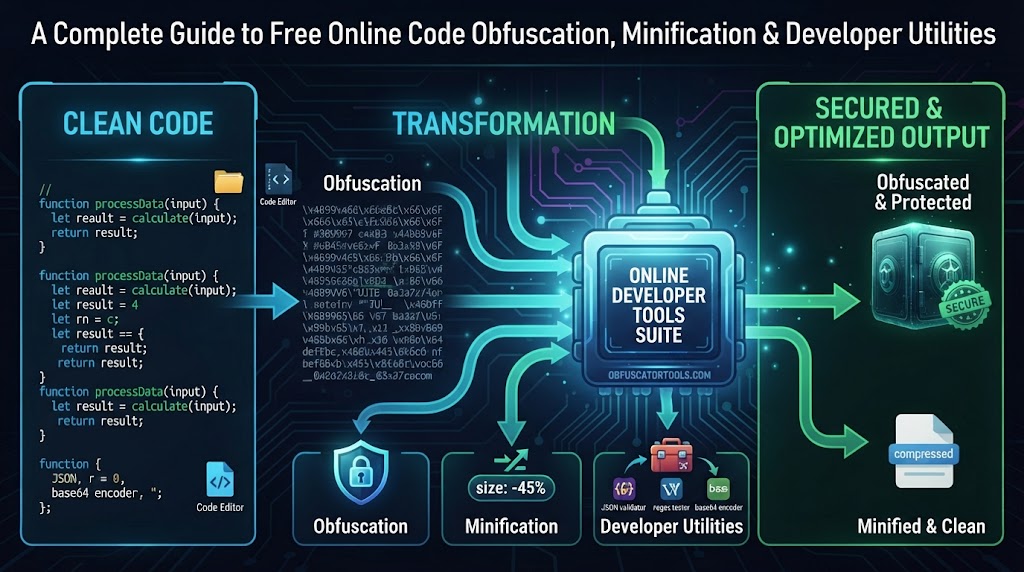
ObfuscatorTools.com Review: A Complete Guide to Free Online Code Obfuscation, Minification & Developer Utilities
Quick verdict: ObfuscatorTools.com is a free, browser-based developer toolbox that combines code obfuscation, minification, encoding/decoding, and formatting into a single no-signup platform. It is built for developers who need to protect client-side code or run quick transformations without installing software or configuring a build pipeline. Everything processes locally in your browser — your code is never uploaded to a server.
Why Online Developer Tools Matter
Modern web development moves fast. Between shipping features, debugging edge cases, and keeping build times low, no developer has time to install and configure a dozen desktop utilities. Browser-based tools solve this by putting obfuscation, minification, encoding, formatting, and validation one click away — on any device, with zero setup.
Traditional workflows required heavyweight IDEs, command-line build chains, and platform-specific binaries. Each tool had its own configuration file, update cycle, and quirks. Moving code between a local minifier, a remote obfuscator, and a browser-based validator was manual and error-prone. Online tools collapse that workflow into a single browser tab — no dependencies, no version conflicts, no system permissions required.
Core Feature 1: The Online Code Obfuscator
The JavaScript Obfuscator is the flagship tool. It transforms readable source code into a compact, unreadable format while preserving exact runtime behavior.
What it does:
Variable and function renaming — replaces meaningful names with short, meaningless identifiers
String encoding — hides literal values from casual inspection
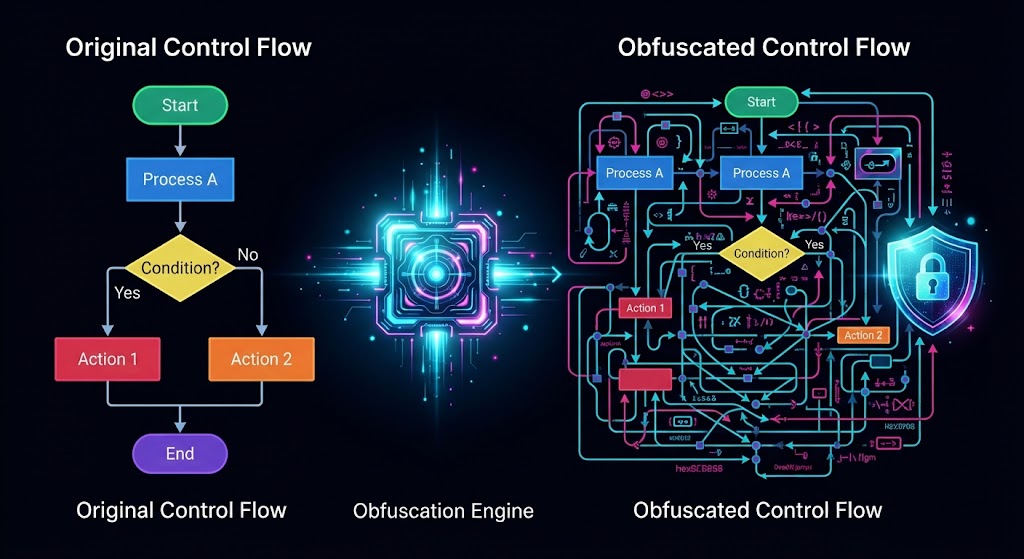
Control flow flattening — restructures logic into switch-based dispatchers that are painful to follow
Dead code injection — adds noise that slows down reverse engineering
Supported languages: JavaScript, PHP, HTML, and CSS.
Important caveat: Obfuscation is not encryption. It does not make code impossible to reverse — it makes reverse engineering expensive and time-consuming. For client-side JavaScript that ships to browsers, obfuscation is the only practical way to slow down code theft, protect proprietary algorithms, and hide API keys from casual inspection. Combined with server-side rendering and legal protection (licenses and copyright notices), it forms a layered defense.
When to use it: Shipping a client-side app, protecting proprietary algorithms, securing embedded scripts, or delivering code to clients or third parties.
Core Feature 2: The Online Minifier
The JavaScript Minifier reduces file size and improves page load speed by stripping whitespace, comments, and dead code. It supports JavaScript, CSS, HTML, JSON, and XML — all generated in real time.
Why it matters:
Minified JavaScript loads faster and reduces bandwidth costs
It improves Core Web Vitals scores, which directly affect SEO rankings
CSS minification removes redundant rules and comments
HTML minification compresses markup without breaking structure
Minification vs. obfuscation — the key difference: Minification removes whitespace and comments but leaves variable names intact, so the code is still readable. Obfuscation goes further: it renames identifiers, encodes strings, and transforms control flow, making the code genuinely hard to understand. For production JavaScript, the best practice is to minify first, then obfuscate — or use an obfuscator that minifies as part of its pipeline.
Core Feature 3: Encoder & Decoder Tools
The Base64 Encoder/Decoder is a daily driver for backend and frontend developers alike. It handles text, images, and binary data in real time.
What the encoding tools cover:
Base64 encode/decode — embed binary data (images, fonts, files) inside text-based formats like HTML, CSS, and JSON
URL encoding/decoding — make strings safe for query parameters
HTML entity encoding/decoding — prevent cross-site scripting (XSS) when rendering user input
JWT decoding — inspect token headers and payloads without server-side verification
Critical distinction: Encoding is not security — it is data transport. Base64 does not protect data; it makes it transportable. Understanding this difference prevents a common and dangerous misconception.
Core Feature 4: Formatters & Validators
Well-formatted code is easier to debug, review, and maintain. A JSON formatter catches syntax errors before they hit production. An XML validator ensures well-formed markup. A SQL formatter makes complex queries readable. A CSS beautifier untangles minified stylesheets.
What the formatting tools include:
JSON Formatter & Validator — beautify, minify, validate with error line numbers, sort keys, convert to CSV/XML/YAML
Code Beautifier — transform minified or messy code into clean, readable source with customizable indentation for JavaScript, CSS, HTML, XML, and SQL
These tools save hours of manual debugging and make code reviews faster.
Code Protection Strategy: The Bigger Picture
No single technique protects code completely. The strongest approach combines:
Obfuscation — rename variables, encode strings, flatten control flow
Minification — remove everything unnecessary
Server-side rendering — keep critical logic off the client entirely
Legal protection — licenses and copyright notices
For embedded scripts and browser extensions, obfuscation is often the only layer available — which makes a reliable online obfuscator an essential part of the toolkit.
Who Should Use ObfuscatorTools.com
Good fit:
Frontend developers who need to quickly obfuscate a script before deployment
Backend engineers decoding a JWT to debug an API issue
Agencies delivering code to clients who want basic IP protection
Anyone who wants a fast, no-install tool for everyday encoding and formatting tasks
Keep in mind:
Obfuscated code can grow in size, and control-flow flattening may affect runtime performance
For large production projects, a build-integrated solution (like the javascript-obfuscator npm package) gives finer control and source map management
Free tools have practical limits; treat online utilities as quick validation and lightweight production helpers, not replacements for a full engineering pipeline
Frequently Asked Questions
Is ObfuscatorTools.com really free?
Yes. The platform is completely free and requires no sign-up, download, or payment for its core tools.
Does it upload my code to a server?
The tools are browser-based and process code locally. Your code is not stored on a server.
What languages can I obfuscate?
JavaScript, PHP, HTML, and CSS.
What is the difference between minification and obfuscation?
Minification removes whitespace and comments but leaves names readable. Obfuscation renames identifiers, encodes strings, and transforms control flow to make code genuinely hard to understand.
Can obfuscation make my code uncrackable?
No. Obfuscation raises the cost and time required for reverse engineering — it is not encryption and cannot make code impossible to reverse.
Does minification improve SEO?
Yes, indirectly. Smaller files load faster, which improves Core Web Vitals — a ranking factor for search engines.
The Bottom Line
If you need a free, instant, no-signup entry point for code obfuscation, minification, encoding, and formatting, ObfuscatorTools.com is worth bookmarking. It is particularly useful for quick one-off tasks, client deliverables, and developers who work across multiple machines and do not want to maintain a local toolchain.
If you need a versioned, auditable, CI/CD-integrated code protection pipeline, treat it as a fast validation tool rather than your only dependency.
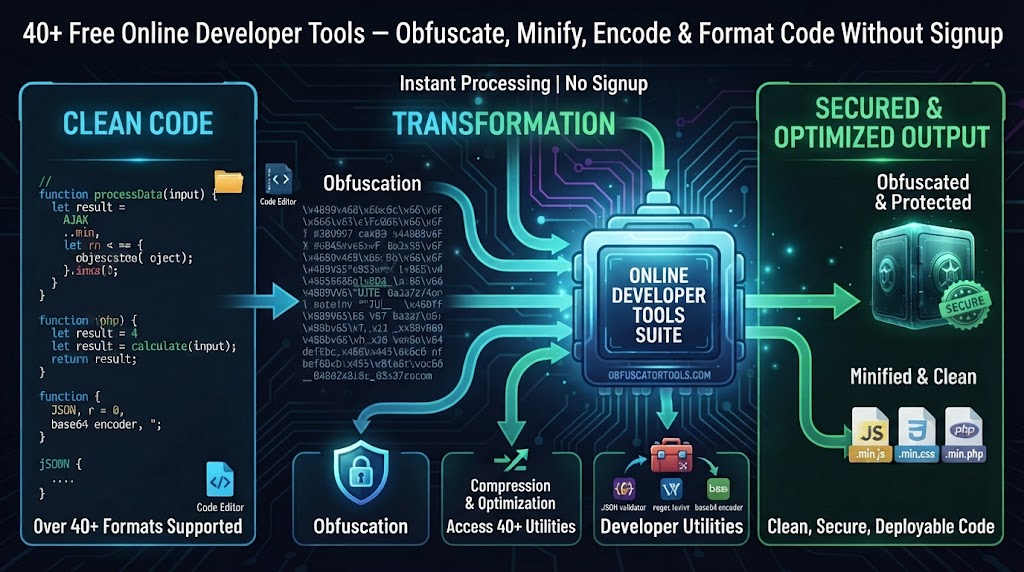
Explore the tools: ObfuscatorTools.com — 40+ free online developer tools, no signup required.
This response is AI-generated, for reference only.

Comments
Leave a Comment